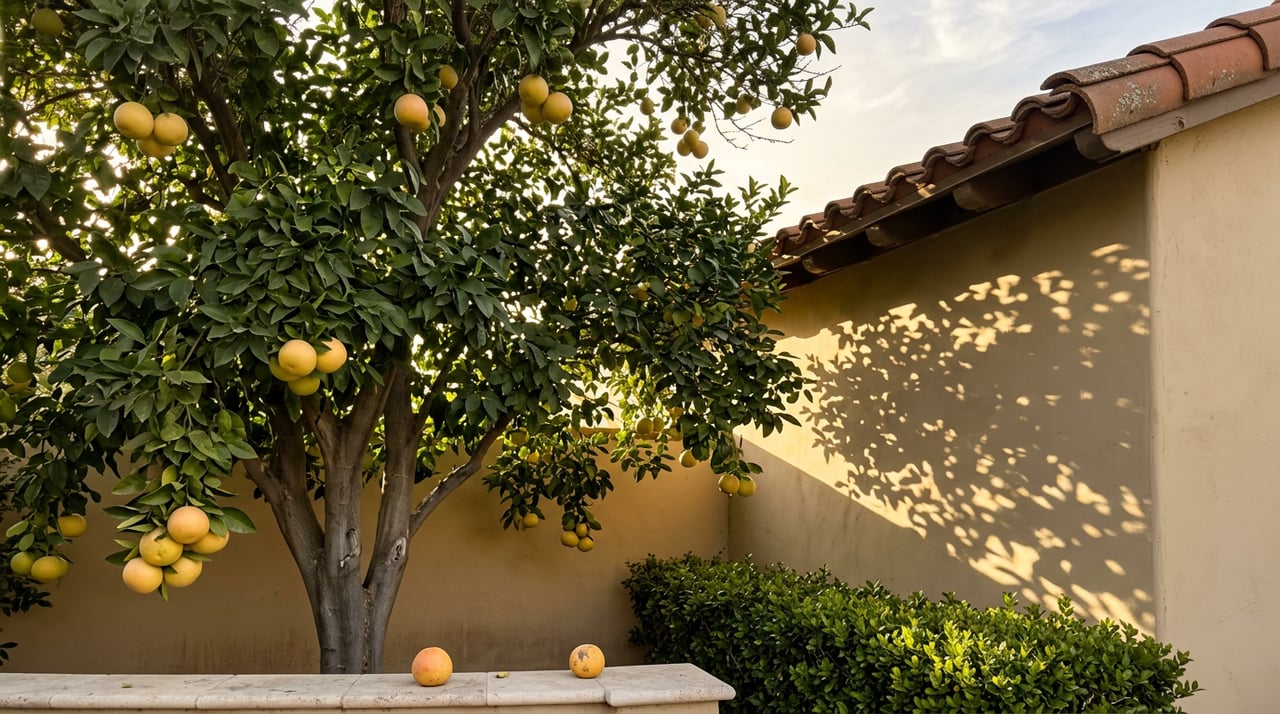
By January, the grapefruit tree in a typical Arcadia backyard is bent low enough to touch the lawn, and the walkway underneath is already sticky with fruit nobody got to in time. This is not a new problem. Arcadia’s citrus landscape reflects its early development: Arcadia was platted in 1919 as a collection of five- to ten-acre citrus orchards, irrigated by the newly formed Arcadia Water Company, and the trees planted then are still doing their job a century later. The St. Mary's volunteer gleaning program described below does not include Arcadia; its zip code limits explain why.
Every winter, a familiar piece of advice circulates around the Valley: if your citrus trees are more than you can use, call a gleaning crew and someone will come pick them for you. It is true, and it is also incomplete in a way that matters if your address starts with 85018. St. Mary's Food Bank, the organization behind most of the Valley's citrus-donation infrastructure, does run a volunteer gleaning program where crews show up with ladders and buckets and clear a tree at no cost to the homeowner. That program is limited to four zip codes: 85351, 85373, 85374, and 85375, all in the Sun City West and Surprise area on the far West Valley. Arcadia is not in that group, and neither is anywhere close to it.
The Gap Between "Gleaning Season" and What Arcadia Can Actually Use
The West Valley gleaning crews operate on their own calendar, and it is worth knowing even if it does not apply to your yard. The most recent season ran from January 12 through March 31, with registration for a crew visit opening the previous October. That schedule applies to the West Valley zip codes listed above. If you live in Arcadia, there is no crew coming to your tree. What you have instead is a longer, less convenient set of drop-off and pickup options that put the labor back on you.
The good news is that one of those options sits inside the neighborhood itself. Shepherd of the Hills United Church of Christ, at 5524 E. Lafayette Blvd., hosted Super Citrus Saturday events on the first three Saturdays of February this past season, from 9 a.m. to 3 p.m., with St. Mary's Food Bank trucks parked on site to take donations directly. That address is a short drive from most of Arcadia Proper and Arcadia Lite. Compare that to the program's other Super Citrus Saturday site, Desert Garden United Church of Christ in Sun City West, which is roughly 30 miles from Arcadia. For Arcadia residents, Lafayette Boulevard is the convenient local option on the calendar. Everything else requires a drive or a form.
Outside of those February Saturdays, the standing option is to haul citrus yourself to St. Mary's Food Bank's Phoenix location at 2831 N. 31st Ave., open Monday through Friday from 8 a.m. to 4 p.m., with donations accepted from mid-January through April 30. That is a full month longer than the West Valley crew season, but it assumes you are willing to pick, box, and drive the fruit there yourself. Arizona's Family quoted St. Mary's representative Jerry Brown describing the scale of the program: "We collect about a million pounds of oranges, grapefruits, lemons, every year." Arcadia's mature trees are a meaningful part of that total, even without a crew ever setting foot on the property.
Two more options fill in the gaps for residents who cannot make the drive. Project Roots runs a pickup-based donation program: fill out an online form and a volunteer comes to your address instead of the other way around, which is the closest thing Arcadia has to the West Valley's crew service. And the Via Linda Senior Center accepted citrus drop-offs through the end of February last season, open Monday through Wednesday from 8 a.m. to 8 p.m., a useful option for the eastern edge of the neighborhood closer to Scottsdale.
None of these routes are difficult. But they all require the homeowner to act, and that is the piece the generic "call a gleaning crew" advice leaves out for anyone living east of the West Valley.
What Sits Too Long Becomes a Different Problem
Fruit that does not get picked, donated, or hauled does not just rot quietly on the lawn. The Arcadia-Camelback Mountain Neighborhood Association has published its own guidance on this, because unclaimed citrus is directly tied to one of the neighborhood's more persistent nuisances: roof rats. Roof rats are drawn to citrus specifically, treating it as both a food source and a water source, and they are most active between November and May, the same stretch when Arcadia's trees are heaviest. The association's advice is direct: pick citrus before it hits the ground, since fruit left in place or left rotting underneath a tree is exactly what a roof rat is looking for. A single breeding pair can produce thousands of offspring in a year, and their foraging range covers a radius of two to three hundred feet, meaning a rat problem in one yard rarely stays there.
This is the part that connects back to the zip code gap. In a neighborhood where a volunteer crew might show up and clear a tree within days, fruit does not have time to sit and rot. In Arcadia, where clearing a tree depends on the homeowner finding time to pick it, box it, and drive it somewhere, or wait for a specific Saturday in February, fruit sits longer by default. That is not a knock on any resident's yard work. It is a structural reality of how the citrus-donation system is built, and it means the roof rat conversation and the gleaning conversation are really the same conversation.
Arcadia's Citrus History
Arcadia's citrus landscape reflects its original development in 1919, when developers marketed five-acre parcels as citrus investments and ran water lines from the Arizona Canal to keep those orchards productive. Arizona's first commercial citrus grove was planted here in 1899, decades before the rest of the neighborhood took shape around it, and the flood irrigation infrastructure that grew out of that era is still what keeps Arcadia's lots greener and its trees more productive than most of the rest of the Valley. Salt River Project's own residential irrigation system still schedules deliveries to older Arcadia lots roughly every 28 days in winter, the same rhythm that has kept these trees fruiting heavily for a hundred years.
Today, food banks, church parking lots and a senior center provide citrus drop-off options. Their schedules vary, so residents need to know which option applies to their address.
A Short Guide for This Coming Season
- If you are hauling fruit yourself: St. Mary's Food Bank's Phoenix warehouse at 2831 N. 31st Ave. typically accepts donations Monday through Friday, 8 a.m. to 4 p.m., from mid-January through the end of April.
- If you want a convenient local option: watch for Super Citrus Saturday at Shepherd of the Hills UCC, 5524 E. Lafayette Blvd., historically held on Saturdays in February.
- If you would rather someone came to you: Project Roots offers a pickup-based donation option through an online request form.
- If you are on Arcadia's eastern edge: the Via Linda Senior Center has accepted drop-offs through late February in past seasons.
- If a tree looks past picking: get to it before the fruit hits the ground. The Arcadia-Camelback Mountain Neighborhood Association's roof rat guidance is worth a read before the season gets away from you.
Program dates shift slightly year to year, so it is worth confirming exact windows each January rather than assuming last season's calendar repeats exactly.
Arcadia's citrus trees are one of the clearest threads connecting the neighborhood's present to the orchards it was built on. Knowing which citrus-donation options are available for Arcadia addresses is part of what it means to live here well.
If you are weighing a move within Arcadia or curious what a citrus-lot property is worth in today's market, Valley Luxury Group knows this neighborhood block by block. Find out what your property is worth.